Healthcare Consolidation is Entering a New Phase
11 August, 2026
Hospital dealmaking has returned strongly in 2026, and the significance goes beyond the number of transactions being announced. The activity points to a broader shift in how health systems are thinking about scale, capabilities, and long-term positioning.
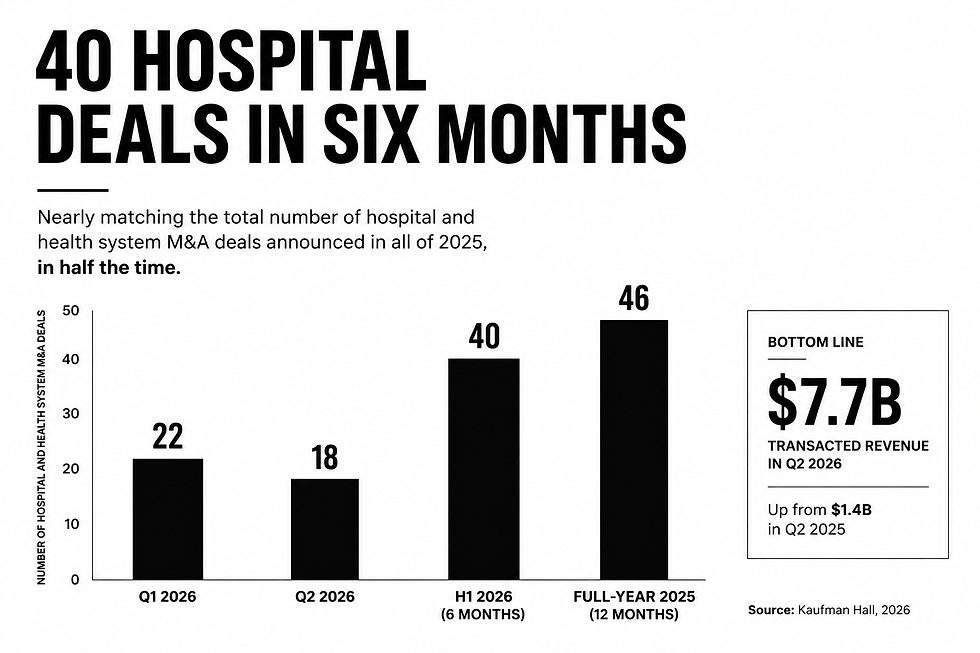
Kaufman Hall recorded 40 announced hospital and health system mergers and acquisitions in the first half of 2026. That is already close to the 46 transactions recorded across the whole of 2025, which was the lowest annual total in 15 years. The first quarter accounted for 22 deals, the strongest Q1 since 2020, followed by another 18 in the second quarter. Q2 transaction volume was more than twice the eight deals recorded during the same period in 2025.
The value of the transactions has increased alongside the volume. Deals announced in the second quarter represented $7.7 billion in transacted revenue, compared with $1.4 billion in Q2 2025. Three transactions involved smaller parties with more than $1 billion in annual revenue, which Kaufman Hall classifies as mega mergers.
What stands out, however, is why health systems are pursuing these transactions. The current market appears increasingly focused on strategic positioning rather than simply rescuing financially distressed hospitals. In Q2, two-thirds of transactions involved independent systems proactively seeking a partner, while Kaufman Hall noted a growing preference for complementary capabilities and opportunities that support long-term strategy.
For hospital operators, scale can provide greater capacity to manage rising costs, invest in technology, and negotiate within an increasingly complex payer environment. It can also create opportunities to expand outpatient capabilities as more care moves beyond traditional inpatient settings. Kaufman Hall’s recent data shows outpatient volumes continuing to grow, adding another consideration to how health systems are reshaping their portfolios.
For mid-sized and independent hospitals, the environment creates a more difficult strategic decision. Remaining independent may preserve local control, but it can also limit access to capital, technology, and specialised capabilities. A well-structured partnership can provide those resources while strengthening a system’s position within its regional market.
For investors and acquirers, the shift raises a different question. The opportunity is no longer simply finding financially troubled assets at attractive valuations. Increasingly, the more interesting targets may be organisations with strong regional positions, complementary capabilities or assets that can strengthen an existing healthcare platform. That makes strategic fit and long-term operating potential more important to the investment case.
Patients will experience the effects differently. Larger systems can bring greater resources, broader networks, and expanded access to outpatient services. At the same time, consolidation can reduce the number of independent providers in a market and increase the concentration of negotiating power. The benefits of scale, therefore, need to be considered alongside the implications for competition and patient choice.
The broader significance of the 2026 activity is that healthcare consolidation is becoming a more deliberate part of growth strategy. After a period of subdued activity, health systems are returning to the market with clearer ideas about the capabilities, markets, and scale they need for the future.
For businesses and investors looking at healthcare over the long term, that is the more important signal. The question is no longer simply how many hospitals are merging. It is how healthcare platforms are being reshaped, and what that reshaping will mean for the businesses, operators, and capital that support the industry.
Sources
Kaufman Hall, Quarterly M&A Activity Report
Chief Healthcare Executive, Hospital mergers in 2026: Five takeaways
Chief Healthcare Executive, More hospital mergers in first half of 2026
Fierce Healthcare, Hospital M&A stays hot in Q2



Comments